Returning a Buddhist Scroll to South Korea
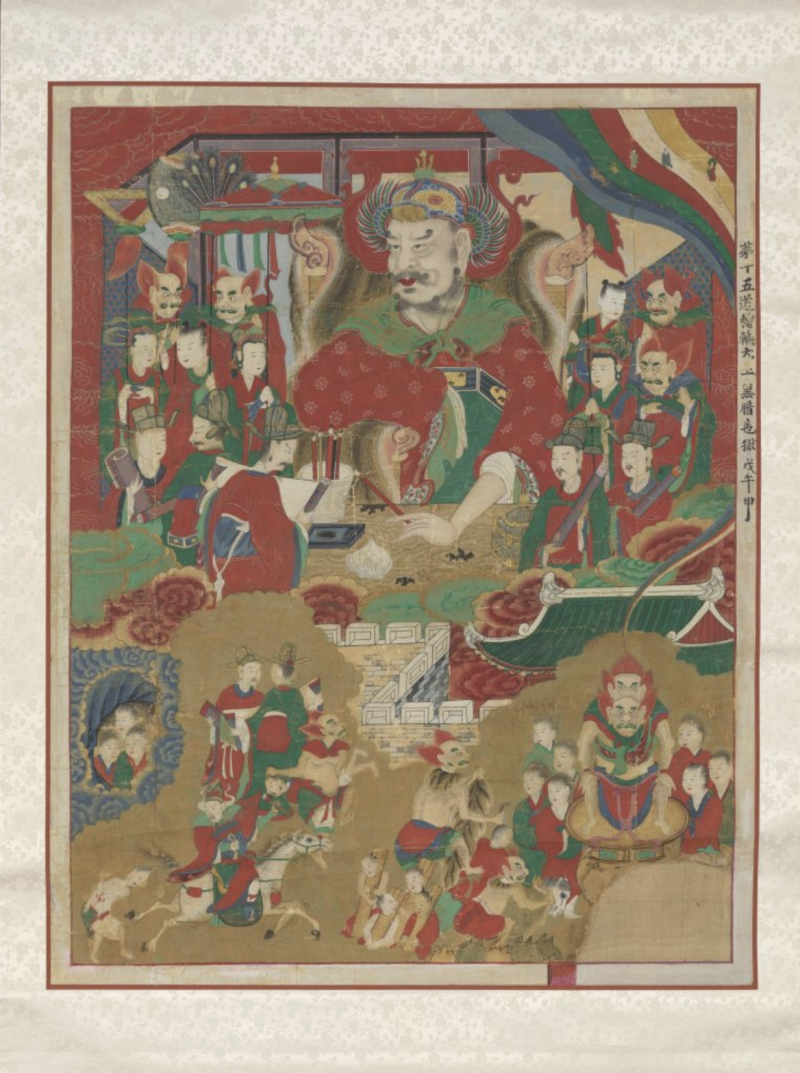
The Tenth King of Hell (1798), Joseon Dynasty, Korea. Photo retrieved from the Metropolitan Museum of Art.
In November 2025, The Metropolitan Museum of Art returned a 227-year-old Buddhist hanging scroll to Sinheungsa Temple in South Korea, acknowledging that the work had likely been removed during the Korean War while the temple was under U.S. military control. The object, The Tenth King of Hell (1798), depicts one of Buddhism’s judges of the afterlife and had been separated from its religious community for more than seven decades.
The return followed a collaborative investigation involving museum researchers, representatives of Sinheungsa Temple, and the Sokcho Committee for the Return of Cultural Heritage. The investigation itself was prompted by sustained advocacy and engagement from Korean stakeholders, who brought attention to the scroll’s wartime removal and pressed for further research. This cooperative approach is significant. Rather than emerging solely from internal review, the process was shaped by external pressure alongside institutional response, demonstrating how ethical action often depends on forces beyond the museum itself. In doing so, the case reflects the possibility of a broader shift museum practices toward accountability, transparency, and historical responsibility.
The Korean War (1950–1953) displaced not only millions of people but also vast quantities of cultural heritage. As temples, cultural sites, and private homes were damaged, evacuated, or requisitioned for military use, artworks were frequently left vulnerable to removal. According to Sunglim Kim, an expert in Korean art and cultural history, noted, objects taken to the United States by soldiers were often not removed under any official directive but were instead collected from sites perceived as abandoned or destroyed. These works now constitute what Kim describes as a “distinct category of cultural loss,” shaped by wartime conditions rather than deliberate policy.
The Tenth King of Hell was one of ten Buddhist scrolls originally housed at Sinheungsa Temple in Sokcho, near the present-day North Korean border. Although the precise moment of its removal remains unclear, photographic evidence from the mid-1950s shows the scrolls intact while the temple was under U.S. Army control, and missing only months later. Decades afterward, the scroll entered the international art market, eventually being acquired by The Met in 2007 from a Los Angeles collector via a commercial art dealer. While the purchase complied with the legal standards of the time, the circumstances of the scroll’s earlier displacement were no longer visible in its market history—an example of how war-time losses can be normalized through time, distance, and repeated transactions. It is precisely this kind of historical rupture that modern provenance research seeks to address. Rather than functioning as a simple record of ownership transfers, provenance research increasingly asks how, why, and under what conditions objects moved through periods of conflict, occupation, and displacement. The investigation did not originate solely within the museum. Rather, it developed through collaboration between The Met, representatives of Sinheungsa Temple, and the Sokcho Committee for the Return of Cultural Heritage, whose advocacy helped bring the object’s wartime history to attention. In this case, that collaborative process ultimately led to the painting’s return, illustrating how cooperative research and external engagement can reshape institutional decisions about objects with contested histories.
Since 2023, The Met has expanded its review of collection histories and invested more heavily in provenance research, including the appointment of a dedicated head of provenance. However, not all restitutions have emerged from proactive institutional review and The Met is defending its ownership in certain cases, such as a claim by the heirs of Jewish art dealer persecuted by the Nazis in France. In cases like the return to Sinheungsa, external advocacy and collaboration played a critical role in bringing the object’s history to light and prompting action. The case is also notable because of the item’s destination: it is a sacred object returning not to a national museum, but to an active Buddhist temple.
For the monastic community at Sinheungsa, the scroll’s return represents more than the recovery of a historical artwork. As scholars such as Jinyoung Jin have argued, repatriations of Korean cultural heritage acknowledge how profoundly war and occupation have shaped the care, interpretation, and survival of religious art. Returning The Tenth King of Hell reconnects the object to the living tradition it once served, restoring a relationship interrupted by conflict rather than concluding it with museum display.
This kind of repatriation is not simply a diplomatic gesture between states, but an act of cultural repair. It challenges museums to reconsider what responsible care looks like in the twenty-first century. Where encyclopedic museums once measured success by the breadth of their holdings, ethical stewardship now demands an ability to recognize when an object’s continued presence in a collection no longer aligns with institutional values.
What makes this case especially meaningful is that the scroll’s return was framed not as a loss, but as a continuation of responsibility. By choosing collaboration over contestation, the museum affirmed that stewardship sometimes means relinquishing physical possession in order to honor historical truth. As more institutions confront the legacies embedded in their collections, returns like this one suggest a future in which museums are defined not only by what they hold, but by the ethical choices they are willing to make. In that future, returning an object home is not an ending—it is the restoration of a story interrupted, finally allowed to unfold where it began.
Sources
Taylor, Derrick Bryson. “MetMuseum Returns Buddhist Painting to Korea After Decades.” The New York Times, November 17, 2025. https://www.nytimes.com/2025/11/17/arts/met-museum-korea-repatriation.html.
The Metropolitan Museum of Art. “The Metropolitan Museum of Art Returns Buddhist Painting to Sinheungsa Temple in Korea.” Press release, November 14, 2025. https://www.metmuseum.org/press-releases/korea-return-november-2025.
Cohen, Alina. “The Met Returns Historic Buddhist Painting to Korea.” Artnet News, November 19, 2025. https://news.artnet.com/art-world/the-met-returns-historic-buddhist-painting-to-korea-2715943.
Farfan, Isa. “Met Museum Returns Buddhist Painting Taken During Korean War.” Hyperallergic, November 18, 2025. https://hyperallergic.com/met-museum-returns-buddhist-painting-taken-during-korean-war/.