Democracy Course Transforms Student Passion Into Public Service
In the University of Denver's Radical Democracy course, students register voters, test their assumptions, and build skills for careers in public service.
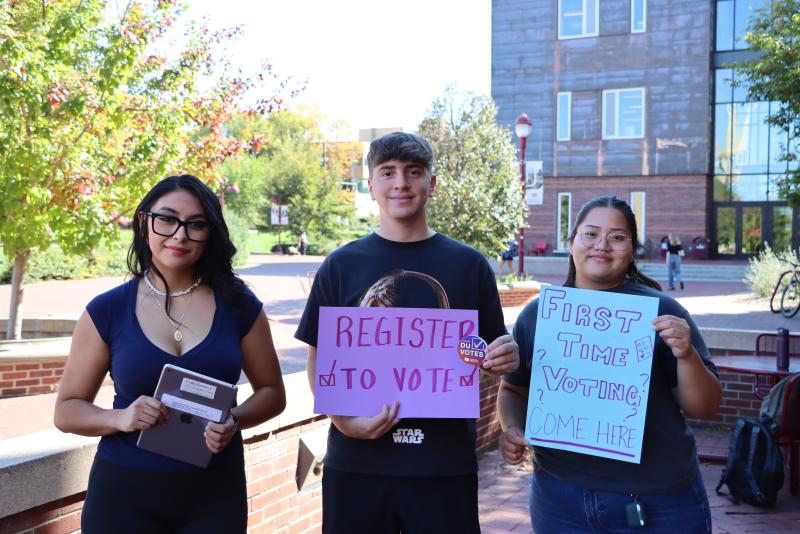
From left to right: Angie Velazco Perez, Jacob Florio, Kiera Tsosie. Photo by Hannah Fulk.
Students in the University of Denver's Radical Democracy class, taught by Associate Professor of political science Alena Wolflink in the College of Arts, Humanities & Social Sciences (CAHSS), don’t just examine and discuss democratic theories; they transform their learning into empowered action through voter registration and personally meaningful public engagement.
“This class pushes students to better understand democracy and think more democratically,” Wolflink said. “That includes developing tolerance for ambiguity and willingness to embrace complexity, frustration, and inclusion in our world, grounded in students’ own political reality.”
Discussions sometimes reveal sharp disagreements and frustrations “even among people who end up voting the same way but for entirely different reasons. We talk about those differences and how to navigate that.”
Occurring this year ahead of and during the midterm elections, the class includes more nonpartisan voter registration drives than ever, with students staffing voter registration tables around campus and visiting political science classes to make registration easier. While students from states with mail-in ballots may have already voted, students registered in their home states who have not yet voted can still register to vote in Colorado and even vote in person on campus on election day.
A continuing partnership with New Era Colorado, a statewide, nonpartisan nonprofit dedicated to supporting civic engagement among young people in Colorado, has again this year connected Wolflink’s students with hands-on opportunities for ongoing involvement.
“I want students to think about politics in new ways, and New Era has a read on exactly the pulse of where students are and what their research shows young people care about,” Wolflink said. “Things like health care, human rights, housing, racial and gender equality, and the environment.”
A representative from New Era typically holds an initial workshop to teach students how to register voters and a follow-up, post-election workshop to debrief and lead discussions with Wolflink about students’ experiences. This year, New Era is also offering a third workshop to teach students how to build a political campaign around an issue they care deeply about and to conceptualize and communicate it in an engaging way.
Impact Beyond the Classroom
Alumnus Matthew Logan (BA ’23), a political science major who double minored in history and communications and currently serves as deputy director of the Colorado Democratic Party and vice chair of the Democratic Party of Denver, took the course in fall 2022.
“We had a voter registration group project and competition to register as many voters on campus as possible,” he said. “The project and partnership with New Era Colorado helped me build strong relationships and connections that eventually helped me become New Era’s senior policy manager in November 2025 and serve in that role through the 2026 legislative season.”
Alumna Frankie Stroud, a triple major in political science, Spanish, and international studies who graduated in June 2026, received a Fulbright scholarship to work as an English teaching assistant at the Universidad Antonio Nariño in Bogotá, Colombia. The collaboration with New Era and Wolflink’s class helped her “realize that our generation is not only capable of creating the changes we want to see but responsible for our own futures.”
New this fall, students can take their engagement to a whole new level by participating in research conducted by the University of Northern Iowa and funded by the Students Learn Students Vote Coalition. The study seeks to better understand what students participating in nonpartisan, on-campus voter registration drives ahead of the 2026 midterm elections are learning about voting and political engagement within the pivotal Gen Z student voting bloc.
"We are the next generation of decision-makers, so it's more important than ever for our voices to be heard,” said Mady Roussin, a political science major planning to graduate in 2029.
Whether or not students participate in the study, they draft a paper in the course using data from Wolflink that shows voter registration demographics among college students and estimates voter registration and voting rates for their generation, both broadly and specifically at the University of Denver (DU).
This experience enables students to identify people who campus voter registration drives failed to reach and design a targeted campaign to reach them.
“The goal of teaching and studying political science is to prepare citizens to be active and engaged,” Wolflink said. “The emphasis on voter registration and related activism allows students to walk away capable and empowered with the skills to implement meaningful change and launch careers in politics.”
Logan, who also serves as a DU Alumni Council member, credits the class and voter registration project with teaching him “the importance and challenges of registering young people to vote (especially on college campuses) as well as the voter protection efforts we can all make to ensure our elections are safe and successful.” He added, “I had some of the most insightful conversations about democratic philosophy in this class and look forward to dedicating myself to a life of public service.”

Put Democratic Theory Into Action
Explore how political science at DU turns political passion into a career with impact.