History Professor Explores How Science Turned Difference into Sickness in New Book
History Professor and Chair Hilary Smith reflects on the communal effort behind her recent publication and why we should rethink what we call “dietary deficiencies.”
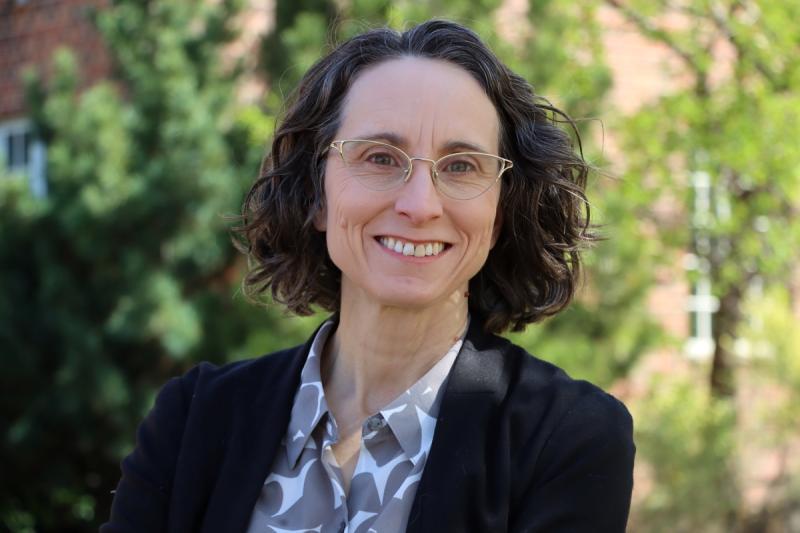
History Professor and Chair Hilary Smith. Photo by Hannah Fulk.
Hilary Smith, professor and chair of the Department of History in the College of Arts, Humanities & Social Sciences (CAHSS), recently published her book, “Nutritional Imperialism: How Science Turned Difference into Sickness in China,” with Johns Hopkins University Press.
For more than a century, Western observers have treated Chinese foodways as evidence of deficiency, danger or cultural backwardness. In “Nutritional Imperialism,” Smith shows how these assumptions entered the heart of modern nutrition science and reshaped understandings of health, diet and difference.
In the following Q&A, Smith reflects on what it means to publish this book and her ambitions behind writing it.
What does it mean for you to have this book published?
It’s gratifying to see something that I’ve spent years researching and writing finally out in the world.
But more importantly, lots of people supported me as I made my way through that work, so I think of it as the fruit of their efforts too. Librarians and archivists in the U.S., Europe, and Asia helped me find sources. Colleagues read drafts, came to my talks, and gave me suggestions. At the University of Denver (DU) specifically, faculty in the University Writing Program helped me stay on track in the weekly writing sessions they hosted. Shoutout to Teaching Professor Megan Kelly, who organized those sessions. I created a couple of classes on food history to help me think through the topic of the book a little more, and in those classes, I always learned a lot from the way students reacted to readings and the questions they asked.
As important as teaching was to shaping the book, I also needed some time away from teaching to complete the research and writing. My DU colleagues, Leasa Weimer, Andrea Stanton and Noelle Strom, helped support the grant applications that gave me the time I needed to finish it up.
Overall, I think of this book as a communal effort. It’s great to be able to finally point to the finished version and say to all those folks, “Hey, look what you made possible!”
Why was it important for you to write this book?
I think what’s useful about the book is that it highlights some scientific ideas about bodies and food that most people are familiar with and shows how prejudice and economic interests shape our perspectives. For example, most of us have heard of lactose intolerance or experienced its effects, but fewer people know that most of the world’s population has the genetic makeup that causes it. Even fewer have asked why we think of lactose intolerance as a defect, especially when dairy isn’t a necessary element of human diets. My book shows that there’s a pattern behind that kind of thinking, behind the idea that some normal human differences should be thought of as deficiencies, that is.
Since I’m a China historian, I looked specifically at deficiencies that scientists have associated with people of Chinese descent, and lactose intolerance was one. Another one was the so-called “Asian flush” reaction that some people have when they drink alcohol. And when you look a little farther back in history, to the early 20th century, you see scientists arguing that East Asian bodies had a sluggish metabolism, or that they had a protein deficiency because of Buddhist vegetarianism, or that rice-based diets were inherently less healthy than wheat-based ones. Just like lactose intolerance or “Asian flush” today, those ideas were taken for granted as solid science in the early 20th century.
A lot of my research, including this book, explores how scientific knowledge is a human creation like other forms of knowing and creating, such as art, philosophy, political and religious systems. Scientific ideas are created by people who have needs, interests, and biases just like any other person. Those needs, interests, and biases sometimes influence the questions that scientists ask and the kinds of data they look at and the way they interpret the data. Looking at the history of scientific ideas — how they were built, who built them — is one way to see the human elements that gave those ideas shape.
In the case of scientific ideas about nutrition and dietetics, a lot of them came into being in the early 20th century at the height of the age of European and American imperialism. During that period, a lot of scientists, including Chinese scientists, assumed that Europeans and Americans were doing things right that the Chinese were doing wrong, including eating right. It was one way to explain the outsized power and wealth that European and American nations had globally. So that assumption fed into the kinds of questions that scientists — again, including Chinese scientists — asked about diets and bodies. They tended to start with the presumption that there was something wrong with Chinese diets and bodies and then try to prove that through experimentation.
The main point of my book isn’t that science or scientists are racist. But scientists live in the same world as everybody else and, like everyone else (including historians!), they share the human tendencies to generalize, formulate questions based on preconceptions, and view evidence selectively. When we look at the resulting ideas in historical context, we can start to see some of the problems in them and hopefully begin to imagine other ways of approaching the same phenomena. For this particular book, I hope that it will help us think more critically about so-called dietary deficiencies. I hope it will help us think about other questions we might ask about bodies and diets, and other ways we might interpret the data.