Interview With English Professor Andrew Kaplan
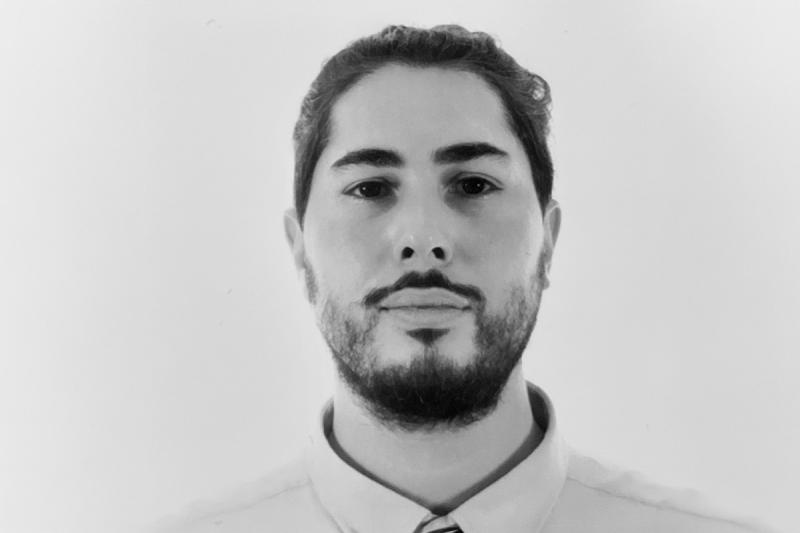
English Professor Andrew Kaplan. Courtesy Photo.
You just received your PhD in Comparative Lit from Emory University. What can you tell me about your time there?
As a first-generation student, I went into this new PhD program with a bit of a hypervigilant disposition because I didn't want to be seduced by the fantasy of “community” that really led to my burnout at my first grad program. I went in deliberately disinvested from “the university” and really just wanted to prioritize the space to do the work, which is organized around this idea of the Black messianic that I developed between grad programs. This time around, I gave myself permission to solely be guided by the project as it was developing. Part of the choice of Emory Comp Lit was being able to have the freedom and autonomy to do so, but the flipside was feeling like I could’ve used more support at later stages when it really mattered around the dissertation and job market.
The other thing that affected my time at Emory was that the pandemic hit in my second semester. Just as I was getting acclimated and beginning to actually connect with people, we went into quarantine. So, along with kind of dealing with a lot of social anxiety and neurodivergent conditions, it basically sunk any chance that I had of being able to experience Emory as a kind of broader intellectual community. I had the space that I was deliberately looking for to do my work, but my experience of the institution was really complicated both by these external factors and also a broader toxic atmosphere that can often come, unfortunately, with well-established R1 institutions.
How are things going at the University of Denver? Do you like the city?
There’s this line from Joyce’s "Ulysses" that’s always stuck with me, which has really been a source of (post)secular “faith” throughout the years: “the longest way round is the shortest way home.” That’s what it feels like to be here: at an institution fresh off its R1 status while still caring about students’ well-being, especially with a department that embodies this with a truly creative and compassionate spirit. Then there’s the added blessings of being in a “blue” state like Colorado and a vibrant city like Denver at a time where it really matters if you're living in a red state. So it’s all been quite fortuitous.
My experience of the city has been limited thus far because, unfortunately, my dissertation funding ran out at the end of May of this year and the start date for the position wasn't until September 1, so I only got my first paycheck in October. With that said, I'm very happy with the neighborhood I landed in near Washington Park. It's been really lovely to experience the lush, walkable environment with all of the beautiful foliage around. Some folks in the neighborhood even have designated wildlife habitats. So, even though I'm in a sub/urban setting, there's still an abundant experience of nature that’s been really welcoming. Although the experience of Denver as a whole has been fairly limited thus far, my experience being here has definitely brought a different quality of life between the weather, the walkability of the city, and all of these kinds of small details that really hindered my post-pandemic time in Atlanta. I finally feel like I'm in a space that I can flourish in.
You’re working on your first book project; what can you tell me about that?
The central problem of the project that I'm trying to think through is how non-Black people can receive, in W. E. B. Du Bois’s idiom, the Black gift of “second-sight” from the other side of “the Veil," particularly through the lens of an apocalyptic orientation (i.e., the original Greek meaning of apo-calypsis as un-veiling). My project’s point of departure is the convergence of Du Bois’s apocalyptic poetics, wherein he plays on the trope of “the Veil” and the speculative “end of the World” (i.e., the color line), and his so-called “lynching” parables that invoke the figure of the Black Christ. That said, it’s also an attempt to situate the contemporary discourse of Afropessimism within a longer tradition of apocalyptic poetics inaugurated in the twentieth century by Du Bois. So, if one bookend is this Du Boisian idiom, the other bookend to the problematic of non-Black receptivity is what Frank Wilderson describes/theorizes as “the Slave’s” invitation to the “dance of social death.”
Afropessimism engages in a mode of paradigmatic analysis, that I insist is simultaneously a poetics, that takes up Orlando Patterson’s sociological theory of social death and reconceptualizes it through Frantz Fanon’s psychoanalytic theorization of the negrophobic unconscious. If Patterson’s comparative world history defines social death as having three constitutive elements, natal alienation (from homeland), general dishonor (in civil society), and gratuitous violence (that’s unprovoked), Afropessimism contends that these elements give shape to a collective unconscious that defends itself against Black non-Being as a condition that persists in the afterlife of slavery. So, Wilderson’s formulation of this “invitation” is meant to provoke non-Black people, especially in the context of coalition-building, to confront the constitutive nature of this negrophobic unconscious. However, as you could imagine, this hyperbolic rhetoric is often misunderstood, and this is where my project intervenes. I think Afropessimism’s charge can be clarified and elaborated most effectively through a philosophical and literary understanding of its latent (postsecular) messianic and apocalyptic logics because these are terms that fundamentally question the legitimacy of the World as it stands by demanding a radical divestment from its most unquestioned values. This is my attempt to articulate a theory about how reading Black radical poetics (broadly conceived) can enable a recursive practice of self-abolition for non-Black people.
In the book project, I’m pursuing this through readings of figures like Wilderson, Du Bois, Aimé Césaire, Richard Wright, Dionne Brand, Saidiya Hartman. I’m analyzing the ways in which they're implicitly and/or explicitly cultivating a poetics of apocalypse that not only does the work of revelation but, in doing so, allows for a different mode of inhabiting the afterlife of slavery. Beyond that, I think that the greatest ambition of the project is to unsettle our ideas about the ends of the World, particularly how they operate with respect to the climate catastrophe. I'm interested in a bit of an ironic wager where it's actually the end of “the World” that will allow us to “save” the Earth, whatever either of those things may mean.
Where are you at now with the project? Do you have ideas for titles?
The book project has taken a number of different configurations. At the moment, it's taken a more distended form with relatively shorter chapters so that I can distribute some of the material that I've already published in ways that will still be a smaller percentage of the overall chapter composition. I've gone through a few different titles; one that may be of interest in the context of our department was "Impossible Writing / Impossible Reading." I got that phrase from Saidiya Hartmann's description of critical fabulation. This was the driving point of my question about how these Black writers in the 20th and 21st centuries were engaging in impossible writing because of the intractable and opaque nature of anti-Blackness from its formation in early modernity (and, in some cases, even earlier). That framing of the title also tied into the kind of theological ideas that I'm drawing on as a way of thinking about the “impossible” here with ideas about the messianic and the apocalyptic. In that vein, the working version of the title that may very well stand is "To Abolish the Things That Are: Toward a Black Messianic Poetics of Apocalypse." This is from a line from 1 Corinthians 1:28 where Paul proclaims that “God chose what is low and despised in the world, things that are not, to abolish things that are.”
Have you always wanted to be a teacher? What does it mean for you to be in this position?
As I proceeded to do my studies and I got more interested in theological ideas, I started to develop a more robust sense of “a calling,” particularly as it stems from the language of “vocation," which was originally associated with an apostolic sensibility. The thing that drove me since I was a kid was the problem of cognitive dissonance, which, in some sense, is an essential kind of question concerning how to get through to other people who are nominally acting against their “interests.” More precisely, I was desperate to help the people in my life understand how the actual way we lived came to compromise the very things we claimed to value.
This problem was a fundamentally pedagogical one, long before I knew it as such, but also a rhetorical one. The question at the heart of it was how to “attune” people to the conditions that they are presupposing and inspire them to revisit these conditions no matter how (literally and figuratively) unsettling it may be. That is essentially what I try to do in my teaching. Frankly, the thing that led me to African American literature in particular and Black Studies in general was a continued interrogation of these different structures of presupposition that lead to the ways in which we take any number of categories of belonging for granted. And that is the way in which I try to cultivate students' attention to these structures of presupposition, by showing how foundational anti-Blackness is to many of the categories that are so familiar to us in our daily life that they feel “natural.”
Do you have any plans for teaching here? Do you have any new ideas, any new subjects you want to teach?
I'm experimenting this first quarter with a variation of an assignment that’s proved effective over the past few years. The original assignment structure entailed having students choose one passage from two different readings completed over a two-week period and put them in conversation with one another. Now, instead of having students write comparative analyses of the specific passages that they've chosen, I'm having them formulate questions dedicated to each specific passage, which then scaffold to a “synthesis” question. This modification follows from my central motivation to get students to realize what they take for granted in their writing because they assume that there is a one-to-one correspondence between what's going on in their head and what they’re writing. The perennial problem is how to get them to recognize the inevitable gap between these things because it is something that is so deeply habituated that they literally cannot see it. So, having them formulate questions is an attempt to get them to think more closely and critically about what they're doing in their writing because they can't just assume that their intended meaning is transparent. It’s also really effective as a “transferable skill” because the power to formulate questions, whether it's in an academic context or whatever they may be pursuing in their daily life, is something that they'll be able to carry with them going forward.
In terms of new courses that I'm interested in exploring, I've been wanting to do a course on autotheory. My interest in autotheory lies in how it allows for the same type of recursive orientation for students to see how writers are drawing on theory to think about and elaborate their own lived experience. It’s particularly effective pedagogically because it helps situate students in a parallel (or convergent) position to help get them to think about how theory is something that can allow them to “see” things (in the sense that “theory” comes from the Greek theōria, which means to “spectate” or witness). And this is something that I'm interested in thematizing and building out within the context of Black autotheory in particular, but also autotheory in general.
You have a new book that you're working on. But where are your ideas headed? What’s next next?
While my project has a systematic quality, it also has a rhizomatic quality because the connections and questions that I'm interested in are kernels that can themselves open unto larger projects. In this first project, if I’m foregrounding the apocalyptic and the messianic as the organizing frameworks for thinking about the work that Black radical poetics is doing and the type of comportment that is called for from non-Black readers, the way in which I see that project developing into a second one is focusing on liturgy as a mystical paradigm of reading.
It's something that I'm interested in using as a primary organizing theme to be able to think about the “metaphysical” qualities of reading and writing. If we think about the Eucharist in the Catholic liturgy as a classic example, the wafer and wine is transubstantiated into the body and blood of Christ, which congregants participate in through their consumption. However, liturgies across spiritual traditions, especially monastic ones, are often practiced through the reading of sacred texts. So, I want to think about something like transubstantiation as the most radical expression of what we try to articulate when we implicitly or explicitly think about “performativity” or the phenomenology of reading, even when the texts in question are not created in a sacred context. In a sense, I don’t think these orientations are radical enough when it comes to conceiving the reader’s and/or writer’s complete undoing of their subjectivity (which is where the related notion of askesis comes into play).
I want to pursue this in a way that ties into the autotheory interest but more expansively so in how I take up various key theorists in Black studies who are also practicing creative writers to think of their theory as literature and their literature as theory, especially where they are not explicitly integrated. So, I have this idea of using “liturgical poetics” as this unifying post-secular idea that allows us to think about reading and writing across discursive registers, and outside of or irreducible to religious contexts, to cultivate a relationship to reading and writing that is singularly attentive to their radically transformative (and de-formative) potentialities. The attunement I have in mind can allow for the potentialities of one's reading and writing practice to actually have this transubstantiating force. This links to the other aspect that's tied into liturgy: I want to think about mystical poetics, which tarries with the ineffable and the unknowable, as enabling us to think about reading and writing as modes of kenosis, wherein the person that initiates that practice is actually evacuated through the very practice itself. In this modality, something is unfolding that can no longer be situated with respect to the language of the author or the reader or the subject. That's what’s on the horizon as something that is growing out of this first project.
Maybe "Impossible Reading / Impossible Writing" would be a good title there?
Exactly! I think this is exactly the place where that title would return.