Interview With English Professor Bin Ramke
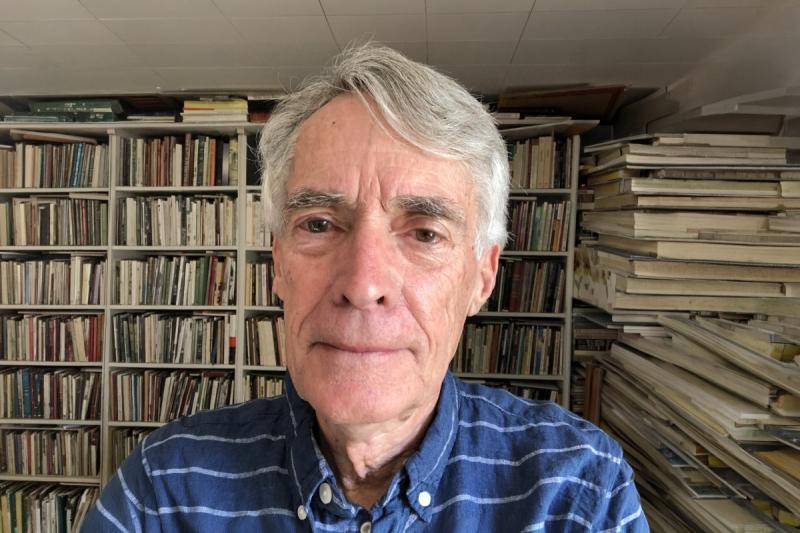
English Professor Bin Ramke. Courtesy Photo.
Could you briefly describe your current teaching, research, and service commitments, and how they shape your work as a writer?
I am currently teaching a senior seminar in which I am trying to examine concepts of art, artifice, fake, and artificial with thought, feeling, imagination, and intelligence. In other words, trying to examine “artificial intelligence” as intrinsically connected to the history of art and literature. It sounds overly grand said that way, but what I am asking my students to do is read old and new works, some of which are called science fiction, some of which are “just poetry,” and find new ways into imagining what both “original” and “artificial” intelligence can be and become.
My service commitments vary, but mostly they involve learning more about my colleagues both in the department and in the university at large, and in that sense they provide a larger context for thinking about my own work, my own contribution to the university and the world at large. Of course committees and advising and reading dissertations and theses on both graduate and undergraduate levels take time, but I can’t really complain since these are all ways of knowing people and encountering new ideas, their actual minds.
Research for me is constant and often invisible. I keep notebooks and often find that my undirected reading is most generative of rhythms and language for poems.
How do you see the relationship between your teaching, research, and service work? Do they inform or reinforce one another in your writing practice?
Yes, but I sometimes find conflicts and complications, especially regarding time. That’s an old complaint, of course. The truth is I seem to be able to find enough overlap among those three sets of obligations to find reinforcement, as your question suggests.
What courses are you currently teaching, and what are the key themes or learning goals you emphasize in these classes?
I dealt with some of this above, but I can say that my undergraduate course, a senior seminar directed at English majors, is a variation on a course I have taught many times in the past on the history and persistence of pastoral, with special emphasis on the implications of artifice, culture versus nature as disembodied in algorithmic processing of language. I want it to sound technical and up to date, but it really isn’t since the “field” hardly exists yet, field in this sense being a way to examine the damage and the gains of this new prosthetic mind. We began to see it happening in the rise of science fiction, but of modernism more generally.
But I have ignored too much of your question: the issue of learning goals. All I can specify is that I hope we all, students and teacher, can find a way into the apparent disjunctions developing between human and human-like.
Are there particular pedagogical strategies or assignments that you find especially effective or meaningful in your teaching?
At the moment, everything I have been doing is up for reassessment. I don’t mean to sound pretentious, but I think it is important to tell the students the truth about my ignorance but share with them my interest in finding reliable ways into the writing we study, and the writing we do.
What writing projects are you currently working on?
During the past year I completed, I hope, a book which is to be published in 2027. As one among many attempts to break away from that project, I began to write sonnet-sized unrelated poems. I have about a dozen or so of these that I am (tentatively) pleased with. Each begins in some sonic realm, begins with a collection of sounds, really. Then, as I play with and among the sounds, a sort of grammar accumulates, and even a sort of consistent “argument.” I tend to be in the process of making poems constantly, and this latest one is only now beginning to show a kind of recognizable shape. I said above they are “sonnet-sized” rather than sonnets, but maybe they will later conform to the history of that form.
What drew you to these writing topics, and how do they contribute to ongoing conversations in your field?
That’s an interesting question. I have tended over the last decade or so (I am old enough to speak that way) to view my “field” in a much broader, older sense than I did in the twentieth century. That is, I am less focused on (and less aware of) the more recent refinements, recent trends in creative writing as a profession. I am, however, paying quite a lot of attention to the technology of writing, of creating, and the impossibly rapid proliferation of artificial intelligence. In some sense, my own writing is now an attempt at examining a boundary between the real and the artificial, which then becomes an examination of my own “intelligence” and/or imagination, memory, habits of language and of observation. I have always been interested in the stochastic processes of thought and mind, the way accidents enter and entertain our writing and reading.