Interview With Alumnus Monroe Lawrence
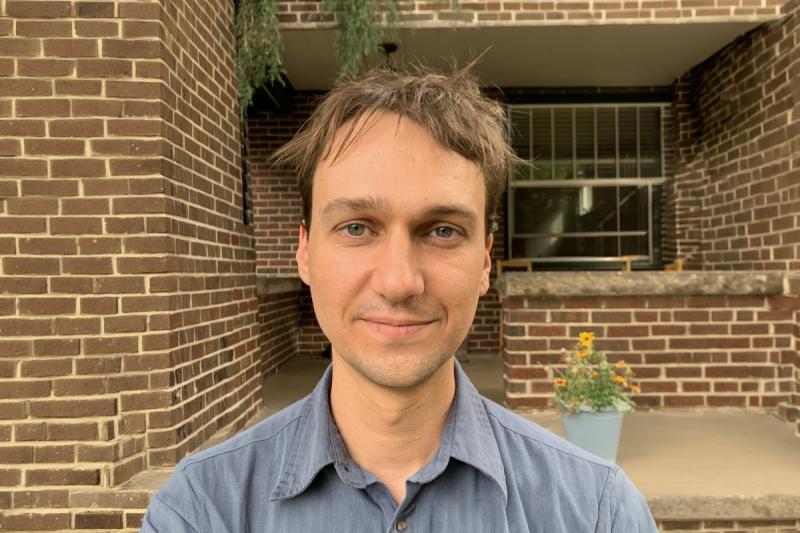
English Professor Monroe Lawrence. Courtesy photo.
Which book of poetry is Gravity Siren for you? How do you feel about it in relation to your last one?
This is my second book of poetry. It is an extension of the mode I was working in in the last one. But it’s also a radical departure, a departure within the same framework. There isn’t a massive ontological difference between how the two books feel and think. I’m using the same type of voice, the same landscape, the same architecture, but building different things out of similar materials. So longer poems, bigger poems. There was one poem in "About to Be Young" that had a certain kind of visual and syntactic architecture, and I took that and used it to build a bunch of the long poems in this book. And then there are still some shorter ones that are more akin to what I was doing in "About to Be Young."
"About to Be Young" had a certain kind of visual and syntactic architecture, and I took that and used it to build a bunch of the long poems in this book. And then there are still some shorter ones that are more akin to what I was doing in "About to Be Young."
What inspired this movement between the two books?
I just wasn’t done with it, and I wasn’t done with the possibilities of "About to Be Young." I liked the idea of maintaining the similar raw material, while building new things, showing maybe like a linearity of voice. I also wanted to write in more legible sentences. The sentence is more important to this book. There was almost this very contrived way that I associated a clear sentence with a kind of growth. And so I was like, oh, I’ll be clearer a little bit, and write in more legible sentences, for what it’s worth. And I was wanting to write longer poems.
Do you have any inspirations for this book?
I was inspired by the work of J.H. Prynne, who recently died, who's a poet who's mattered a lot to me. I think people think about Prynne in terms of his difficulty and the impenetrability of his writing. But I was just really interested in this book, "The White Stones," for its lucidity and beauty. I love how beautiful those poems are, and I felt like I was in a place where I was less and less interested in a lot of what was happening in the poetry around me. But amidst that disinterest, I still found these poems so beautiful. So I set out to replicate some of the maneuvers of "The White Stones," and to not feel ashamed about that. Because there have been times in the past where I've tried so hard to avoid copying people. And this time I was like, no, this is a kind of beauty that I want to try to further.
How did you think through the shape in this book? Especially in regard to white space and the shape of the page?
I think there are a few answers. One is that I just like the way text looks. I just love it. I like making shapes with text. I love that sculptural quality, and the way a poem looks is as important to me as what words come after what. But there’s this totally ineffable experience where you're reading the poem and experiencing the semantic meaning of the words and the syntax - the meaning, the content of the words - while relishing in the shape at the same time. I also like the idea of encountering text, or really any type of art, and not really knowing what it is. Like, is this a poem? And so, with the lack of titles, I want poems to really feel like they could just be a scrap that somebody left at the printer. And in terms of the shape - I was worried because the poems are so small, some of them, and I was worried that the big square page would dwarf or engulf them. So the book could have been published in a different form, and it would have been different. Definitely some of those small poems are really sort of swallowed by the book. And some of the longer ones lay really well
How do you sort out sequencing?
Sequencing is huge, especially when you don't title the poems, and you just have each one page after page. I don't think about a sequence at all until I feel like each page is like really polished. When I feel like I have a book's worth of material, I sit down and almost brute force it, where I’m like, what’s page one? And then I’m like, okay, what’s page two? And eventually I’m on page 33, and each time I read it through, the whole thing, to have a kinetic sense of what page is next. And I wait for my body to figure out what page is next. Then I might change it the next time I go through, but it's a very brute-force intuitive process. And there are many other sequences that could exist. I feel like the book contains so many possible sequences, and this is just the one that I found.
From my reading, the most prominent descriptor that comes to mind for these poems is the word “radiance.” There’s a lot of gleaming and steaming and rippling off of things. How did you think of image and feeling in this book?
This may come from "The White Stones," this feeling of magic - which is not a word that I'm especially drawn to in my ethical landscape or social landscape - but in an aesthetic landscape, I'm really drawn to it. I wanted the poems to feel both deeply real and drawing on the details of our present day, and almost like they contain a glimmer of the speculative and the future. There's that poem at the end that feels like there are spaceships in it. So I wanted the poem to register the intense damage of contemporary life, especially ecological damage, while holding a tremendous possibility and sense of the natural world, rock, wood, stone, plant matter, sort of glowing, taking on hallucinogenic qualities, to drive home the damage at the heart of our lives, but also to evoke some possibility of another way of relating to each other and to the landscape.
What's your take on the lyrical “I”? And where do you find yourself in these poems in relation to nature?
In a very nuts-and-bolts craft sense, the I is a letter. It looks a certain way. It's beautiful. It's a very symmetrical, strong letter that evokes a lot. A word, in addition to being a letter. And it’s like a color. You paint with a different color. A word is like a color that you use as much as it refers to something in my life or in the world. So there's that sense in which I think about the lyric "I." It can make people feel things, and that letter has a lot of charge, and it has a lot of vectors of emotion. That is obviously obscuring the fact that, yes, it's just a very natural letter and word to use because I'm writing about myself a lot of the time and writing about things that flow from me, from my “I.” And, to the 2nd part of the question about ecology, if I had to summarize what the book is about to me, it’s about the possibility of intimacy and small-scale human connection - meaningful, small-scale human connection - in a vastly damaged, massive world that is ecologically threatened and burning. So how do we be intimate with one another, given that there's just this massive shadow of crisis all over us all the time?
Right, one of the most impactful and grounding phrases that gets repeated is “what else is there but expressing to others how you feel about them?”
That's a sentiment that really flows from "About To Be Young," too - this raw, embarrassing expression of emotion. I love embarrassment. I think a poem is embarrassing. It's incredible to me to think otherwise. To pretend it's not is psychotic. I want to write about the embarrassment and have embarrassment, almost like a cringe, in the texture of the language to sort of register the shame of speaking so earnestly.
Finally, I noticed in the acknowledgments that you say "Gravity Siren" was written with your partner, Rowan; could you say more about this?
As I was revising the acknowledgments, I liked the way “with” felt, because while we didn’t write them together, I wrote them while being with them, talking to them, being in love with them. It was not a collaboration, but I was living in tandem with them, and they inspired me a lot. That’s why I said I wrote it with them; you could say they’re love poems.