Interview With English Professor A. Rafael Johnson
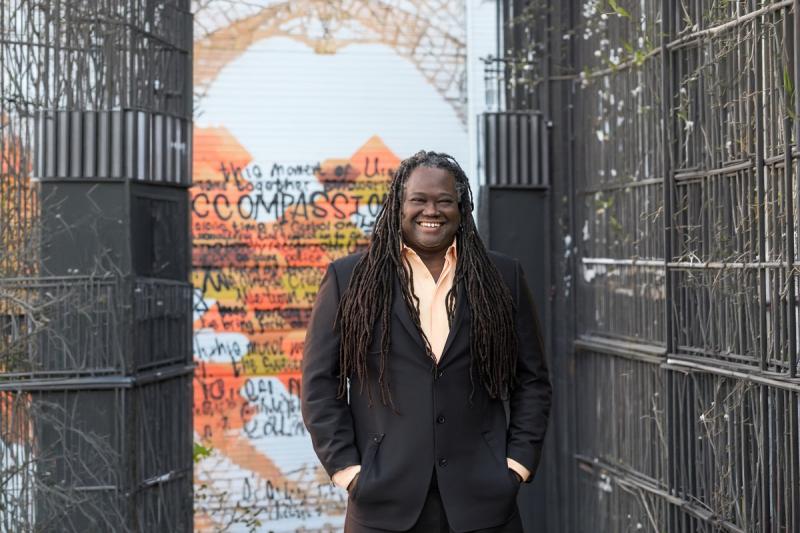
English Professor A. Rafael Johnson. Courtesy photo.
You just came from a teaching position somewhere else. What can you tell me about your time there?
I was employed at two places simultaneously before here. One was the Minneapolis College of Art and Design. The other was the University of Nebraska at Omaha, in their MFA program. And I still work with the MFA program. But as for MCAD, it's an art school, and one of the amazing things about working at an art school is that no student goes to art school to make their parents happy, right? People go to art school because they’re chasing their dream. This is their passion; this is something that they've done for a long time. It was great to have really passionate, dedicated students like that. That being said, they weren't passionate or dedicated to creative writing. They were there for something else. I had to learn how to teach people in a variety of majors that I didn't know much about: Illustration, filmmaking, animation, fine art painting, all sorts of stuff. It was good to get out of a really sort of academic mode, because I'd been teaching in a very academic way, I think, before then, when I was at Alabama. But teaching at MCAD really helped me sort of broaden my focus.
Have you always wanted to be a teacher? What does it mean for you to be in this position?
I was born in a little town in New York State outside of Binghamton called Johnson City. And my mother, at first she was a stay-at-home mom, but then she went to grad school at SUNY Oswego. Some of my earliest memories are being in class with her while she was teaching. I have very vivid memories of her being a teacher, good and bad. We moved from New York to Texas, where she was a teacher, and again I got to sort of observe some of her work in the classroom, just, you know, on those days where the kid has to come to work with you, I guess. Then as we moved back to New York, where I went to high school, I went to a very bizarre high school.
Then I started working in higher Ed, where I had staff positions long before I even started writing. Some of the things I saw there really put me off being faculty. Some abuses of power and some other sort of unsavory stuff I saw just made me think, you know, this isn't really my path. I don't want to become this person. The thing that really changed it is that halfway through my grad program, I quit and became an aid worker and taught at this tiny college in Liberia called Cuttington University. And that's where I saw how teaching, the kind of teaching I wanted to do that could really change somebody's life. And it was hard. We had almost no resources. Some of my students were illiterate. But I saw people able to take charge of their lives just because they could write a simple letter. Or they could read a government edict and decide what it meant. I was on a subcommittee to rewrite the Higher Education Law in that country. The general idea was to reset the education system after the [Liberian] Civil War. I did a lot of teaching in and out of the classroom, and reignited that passion for teaching.
How are things going at the University of Denver? Do you like the city?
I like my students a lot. I like the class I've been teaching. The grad students that I've met so far, I like a lot, and I think we're going to work well together. Denver seems like a lovely place. I haven't had time to see that much of it. I did do the art walk a couple of weeks ago, I guess last month, yeah. And that was a lot of fun. So, yeah, we'll see.
Do you have any plans for teaching here? Do you have any new ideas, any new subjects you want to teach?
I'm thinking about a fantasy class. I think especially among undergrads there's a big want for that. I’m also still thinking about this class I suggested during my job talk, which is based around a lost medieval Muslim city called Songo Mnara. It's on the coast of Tanzania. There's an archaeological dig excavating the city, and they found all of these oddities. There was a women's mosque in the middle of the city. They didn't know why. They didn't know who it was for. The whole city seems to have been a planned endeavor, so it didn't evolve organically. Somebody built a full town at once. And there were questions of, well, who had that kind of money? Right? To build this whole city? And if they had that kind of money, why didn't they just stick their names on it? Why'd they put a women's mosque? There just kept being these questions. My idea at the time was to gather up a group of writers, probably MFA writers, and maybe some advanced undergrads, go there and help with the dig and then write about what we found or what we didn't find. And that could be travel writing, it could be historical fantasy, it could be poetry, it could be medieval. It could be anything. Since then, I found out that the dig ended. And they've answered some of the questions. I'd still like to go, though. It's fascinating. Unfortunately, Tanzania is going through a period of political upheaval, so now is not the time for that.
Your job talk was focused on magical realism. How did you go about incorporating those ideas into your first novel, "The Through?" How do you go about translating more critical, intellectual beliefs into a text itself?
When I was writing it, not very consciously. I did a lot of study before I wrote "The Through." AI did a lot of work in Black feminism, a lot of work in neo-slavery narratives. But also a lot of work in sort of the craft of fiction. For that book in particular, there was an essay by Italo Calvino called “Lightness." It's a lot to summarize, but essentially he says, part of the work of the writer is stepping lightly over really heavy subjects, like death. I think that wormed its way into my brain. The original image I had for "The Through" was a woman carrying a slave ship on her head, and that slave ship, that floating flying slave ship, the Yemaya in the book, that's my idea of lightness. Of taking the heaviness of transatlantic slavery and transmuting it into something else for my needs. And not being sort of weighed down, or chained down by the history.
Something you can carry?
Yeah, something I can carry and sort of bring to me when I need it. But also let it go when I don't need it, because I don't need to think about that every second every day. As for the general proposition of how do you take all this theory and put it into creative nonfiction or poetry or fiction or whatever it is, I would say sort of the same thing. Go very lightly. When I think about my characters, they are not ordering their lives because of an essay by a literary theorist, right? Or you know, an article on magical realism. That's not how it works. I think the lives of real people and the lives of my characters come before the theory. And then the theory can, if it wants to, catch up to what people are actually doing. But I have rarely seen a situation where the theory dictated what happened in real life. So when I write, I try to follow that pattern. And if a character does something that doesn't match the theory, then that's what they did, and that's real life. When I'm writing these stories, I'm also thinking about my parents and my grandparents and my extended family that would tell stories like this. And they didn't care about [theory]. They'd never heard of it, didn't want it. But that doesn't make their stories any less valid. Because I had that same dilemma, I've learned about all this stuff, but how does it get in? And the answer is, in some ways, it has to wait until people do their thing or the poet writes a poem or the writer writes a play or a short story or something, and then we can see how it fits.
It sounds like you’re describing the writer as a site where the theory combines with the real. So whatever you write is going in some way that comes out of that understanding.
I think of it in this way. Okay, hold out your hand.
*Johnson holds his hand as if he is grabbing one end of a rope, between us. I do the same.*
Like this. Okay, now pretend we're doing, like, a tug of war, right?
*We pantomime pulling at each side of the rope, tense between us.*
That's what can happen so often in English departments. The MFA is over here, the PhD is over there, and we're sort of fighting, right? Now let's do jump rope.
*Andy and I start to rotate our hands in counterclockwise circles, like jump rope.*
Okay, there's still that necessary tension to keep things going. But if we put the text in the center of that jump rope, now there's play, there's flow, there's rhyme, there's joy; all the things we want from literature start happening. My essential question is how does the text get written? And the PhD essential question is how do we understand the text? When we start playing together, then all sorts of things happen, right? When we're fighting each other, then we have stasis. I think we have a healthy department here; we have a play between both. We're able to jump to move around. And the text is free to sort of find itself in there. As long as we’re more in service to the text than ourselves, then we're probably on the right path. Once we start getting locked into silos and advancing our own agendas, then we start to squeeze out the text. And that makes no sense. For an English department.
You’re working on a new book titled "For You, Why Should I Cry?" What can you tell me about it?
It's a short story collection. In some ways it makes sense to me, and I guess my publisher decided it made enough sense to give it a go. But the stories are all over the place. I'll leave it up to people as to whether there's a theme to it or not. There are some stories that are pure fiction, like “For You, Why Should I Cry?”, which is about the two people who become the last two people on earth. It's an Israeli and a Palestinian who spend the days insulting each other and throwing rocks at each other. But then, at night, they go home together, cause they're married, and they're deeply in love.
There's another story called “I, Marlon James." It's what I would call a speculative memoir. Its memoir, but it's about thoughts I had or, you know, daydreams or fantasies or decisions I didn't make. Marlon James, the author, and I used to live about a half block away from each other in Minneapolis. And I got mistaken for Marlon James a lot. And since he's so famous, a lot of people knew him. But I've never met him, so they'd always ask me whether I met Marlon James, or whether I write like Marlon James. It just got under my skin. And one day I was in a bar, and this woman started hitting on me because she thought I was Marlon James. And at the time, I was like, okay, you're really confused. Go away. But then later on, I was like, what if I'd said yes? What if I'd run with that? So I wrote this manic story about the time this beautiful woman hit on me because she thought I was Marlon James. It doesn't work out. But one of the things I've learned to have fun with is letting my characters make really stupid decisions. At my age, I've acquired some wisdom, but what if I was an idiot? Like what would happen if I took the worst approach possible to many things? That story comes out of that, and it was a lot of fun. It was a lot of fun to write.
You got the new book that you're working on. But where are your ideas headed? What’s next?
Probably another book. I've been writing these short, speculative memoirs, and so maybe a longer one. I do have a call, though, to just like write more fiction, maybe another novel. I had a novel that I was working on that I got so frustrated with; I don't think I'll ever finish it. But there were other options. I'm still tempted to go back into that world of "The Through." And I do have that short story collection coming out in 2027. In that collection, there are a couple of stories that dip back into the world. I feel like it's not entirely done with me. I did start a sequel that went completely off the rails, but I think at some point I'll be ready to write a bit more. I think Ben's story is not quite done. He was not the main character of "The Through." I think he's got something more to say. So probably I'll be writing something. And teaching.