First-Gen Alumna Now Helps Families From the Other Side of the Desk
As a child, Anahi Quezada-Villa watched her parents navigate the immigration process. Now, this DU alumna represents immigrant families as an associate attorney.
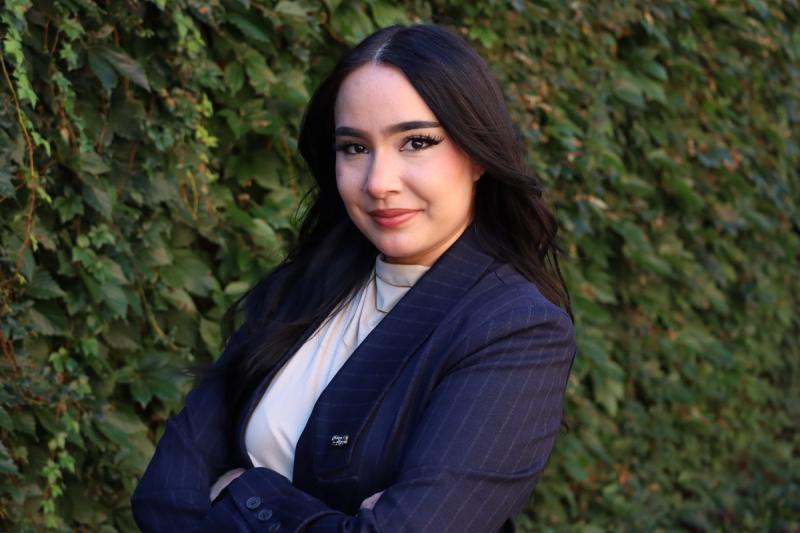
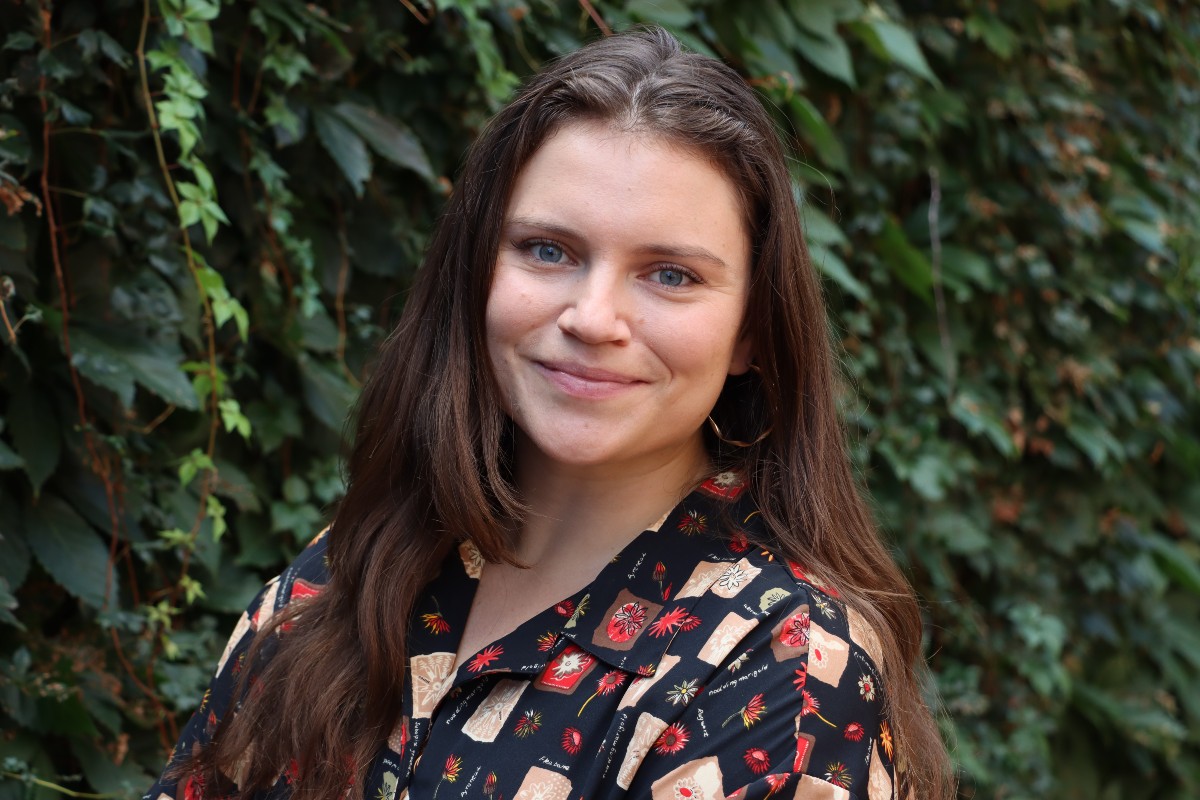
Anahi Quezada-Villa. Photo by Hannah Fulk.
As a young child, Anahi Quezada-Villa (BA ’22, JD ’25) sat with her parents as they went through the immigration process. She saw the struggles that came with this process, including language barriers and a complicated legal system.
Today, the College of Arts, Humanities & Social Sciences (CAHSS) alumna sits on the other side of the desk, helping other families through that same process.
Quezada-Villa earned her bachelor's degree in criminology from the University of Denver (DU), with minors in psychology and ethnic studies. She went on to earn her Juris Doctor from DU’s Sturm College of Law. She is the first in her family to graduate from high school in the U.S. and the first to earn a degree from a four-year college.
“It’s a huge thing for my parents to send me to law school and for me to become a lawyer,” Quezada-Villa said. “I watched them navigate the system growing up, and it really inspired me to make an impact and give back to the immigrant community.”
She now works as an associate attorney at the Meyer Law Office in Denver, where she focuses on removal defense, representing clients facing deportation, primarily at the Denver Contract Detention Facility in Aurora. She is also admitted to practice in the U.S. District Court for the District of Colorado and the 10th U.S. Circuit Court of Appeals.
Quezada-Villa goes to the Aurora detention facility a few times a week for court proceedings or to meet with detained clients and assess their cases. She also handles cases on the Denver Immigration Court’s non-detained docket, which includes cases for people who are not in custody but still require legal representation.
“A lot of people grow up admiring lawyers,” she said. “It’s hard work when things move quickly, and new laws are implemented, but I think it’s very meaningful and worth it at the end of the day.”
Degree in Action
Much of Quezada-Villa's work draws on what she learned at CAHSS. “My criminology background is something that I am implementing now,” she said. “It’s not just a study of the law and our criminal legal system, but it’s also working to understand how our criminal legal system impacts people differently, whether that’s immigrant, Black, Indigenous, and People of Color communities, or how our systems aren’t always designed to support these groups.”
Quezada-Villa noted that being a student in CAHSS gave her room to explore, as she had the chance to choose a major and multiple minors to broaden her student experience personally and professionally.
Her undergraduate psychology coursework changed her perspective on the people she represents. "Sometimes circumstances leave little choice for a better life," she said. “They are then penalized by a system that works only in black and white. My mission is to challenge the system and fight for my clients.”
“Studying criminology and psychology together allowed me to learn how to think differently,” she said. “There’s not one way of seeing the world, and these programs gave me an opportunity to see the world through someone else’s lens.”
For Quezada-Villa, the CAHSS First-Generation College Student Program was especially meaningful, and she also joined the Latine Student Alliance during her time at DU. “I felt like I was getting the support that I needed. Being around people who are like you really helps,” she said.
Guiding Principles
Nowadays, Quezada-Villa approaches every case with empathy and practices trauma-informed lawyering. In her view, the legal system runs on logic and solutions, but people often just want to be heard. “I think it’s important as a lawyer to step back and acknowledge that the system is difficult and, in my work, often trying to separate families,” she said.
As a Spanish speaker, she wants to make communication as easy as possible for her clients. “The other part of my job is being culturally informed as a lawyer,” she said. “A lot of times, clients don’t speak English. I remember the language barriers in offices growing up, and I want to remove that barrier when I can.”
Quezada-Villa wants to keep growing as an attorney and challenge the ways immigration law is practiced. Each time she works with a client, she sees herself and her family in the person sitting across from her desk - someone hoping for a better system.

Find Your Support System
CAHSS connects first-generation students with the support they deserve.