Faculty Profile: Yi Qun Xu, cello
Xu joins Lamont as Assistant Professor of Cello, bringing with her a teaching philosophy grounded in individuality, flexibility, and the belief that musical growth cannot be reduced to a single formula.
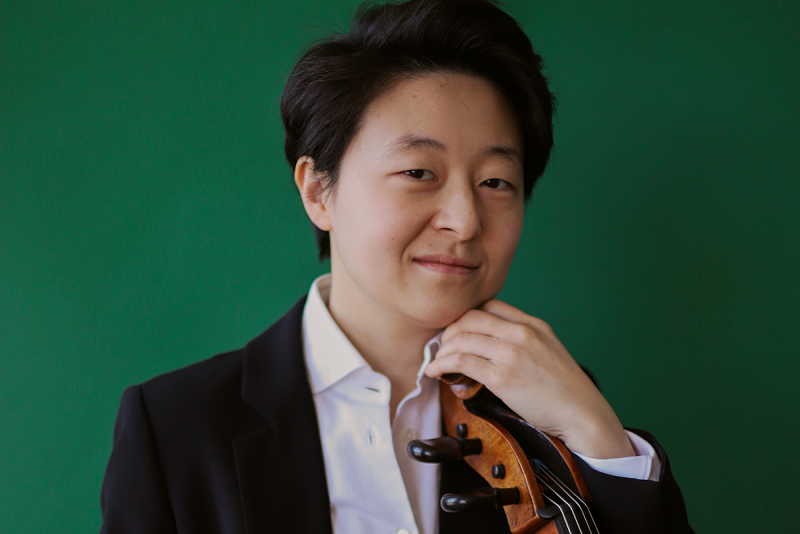
For Yi Qun Xu, the cello was love at first sound.
Growing up in China, Xu was surrounded by family members who loved music, even though none were musicians themselves. Her mother encouraged her to explore music from an early age, first enrolling her in keyboard lessons. At four and a half, Xu began studying violin, but she soon encountered a problem: She couldn't quite figure out how to make the instrument vibrate.
Then she heard her neighbor's sister playing the cello.
“I immediately just fell in love with it,” Xu recalls. “I told my mom I just really wanted to study the cello.”
That early fascination quickly became a serious musical pursuit. After studying with a local teacher for about a year and a half, Xu auditioned for the elementary school attached to Beijing's Central Conservatory of Music. She was accepted and began her conservatory training in fourth grade, studying in China through eighth grade before coming to the United States.
Her path eventually took her to the Walnut Hill School for the Arts, the Colburn School, and The Juilliard School, where she earned bachelor's, master's, and Doctor of Musical Arts degrees. Along the way, she studied with some of the cello world's most distinguished teachers, including Joel Krosnick, Timothy Eddy, Ronald Leonard, and Laurence Lesser.
Today, Xu is an accomplished soloist and chamber musician whose career has taken her to stages and festivals throughout the United States and internationally. She is the cellist of the Cassatt String Quartet and has performed with and alongside artists including Itzhak Perlman, Ani and Ida Kavafian, Carter Brey, David Finckel, and members of the Cleveland, Ébène, Emerson, Juilliard, Orion, and Tokyo Quartets. Her performances have been featured on WQXR's Midday Masterpieces and the acclaimed podcast Here's the Thing with Alec Baldwin.
Her accomplishments include the 2022 Presser Music Award, First Prize in the 2021 New York International Artists Cello Competition, and numerous other competition honors. She has appeared at leading chamber music festivals including Marlboro, the Perlman Music Program, Music@Menlo, Kneisel Hall, and the International Musicians Seminar Prussia Cove.
But for Xu, a life in music has never been solely about performance. Teaching has become an equally important part of her artistic identity.
In Fall 2026, Xu joins the University of Denver's Lamont School of Music & Theatre as Assistant Professor of Cello, bringing with her a teaching philosophy grounded in individuality, flexibility, and the belief that musical growth cannot be reduced to a single formula.
“I truly believe everybody grows at their own pace,” she says.
That belief shapes the way Xu approaches each student. She recognizes that students learn, process, and retain information differently, and she sees the teacher's role as finding the approach that allows each individual to thrive.
“As a teacher, I stay sensitive, adaptive, and flexible to each one of their needs,” she explains. “Part of the job is figuring out what works best for the individual student in order to get the most effective teaching, as well as maximize their potential.”
For Xu, that means looking beyond technique alone. She believes technical mastery and artistic expression are inseparable: One continually informs the other.
While students must develop the fundamental skills necessary to play the cello at a high level, Xu also wants them to develop lives and perspectives beyond their instruments. She encourages students to read, experience the world, and cultivate their imaginations so that their musical ideas have something meaningful to say.
“When they have musical ideas, their technique can support that,” she says. “Or when their technique is influenced by the music, the music can really, truly speak to the audience much more freely at their imagination.”
Ultimately, Xu's goal is not to create students who depend on their teacher for answers. It is to give them the tools to find those answers themselves.
“The goal for me, actually, is to teach them so that eventually they can be their own teacher,” she says. “So they don't need us anymore.”
At Lamont, that philosophy will extend beyond the individual cello lesson. Xu's students will participate in studio classes, chamber music, performance classes, orchestra, and a wide range of other musical experiences. As a chamber musician herself, she particularly values the opportunities for students to learn how to listen, collaborate, and communicate with other musicians.
That collaborative spirit is central to Xu's own career. As a member of the Cassatt String Quartet and a frequent chamber musician, she has built a musical life around the idea that great music is created not only through individual excellence, but through meaningful relationships with other artists.
Xu brings that same spirit to Lamont. She was drawn to the school not only by its artistic opportunities, but by the sense of community she encountered when she first walked through its doors. The building and its facilities made an immediate impression, particularly the recital hall and its acoustics. But what stood out most was the people.
“Our faculty, the staff, the students, we all work together as a team,” she says. “It is such a close-knit family that everybody knows each other so well that you'll feel very supported and very well taken care of.”
That sense of connection resonates with Xu's vision of what a music education should be: rigorous, individualized, collaborative, and deeply human.
“I am honored and thrilled to join the Lamont School of Music,” Xu says. “I look forward to working with students, helping them shape their musical voice and prepare them to be dynamic contributors and leaders in the world of music and beyond.”