From Archives to Audience: 2026 Senior History Conference
Graduating history majors Claire Chapman and Annie Mulvihill presented their senior capstone research at the 2026 Senior History Conference in March.
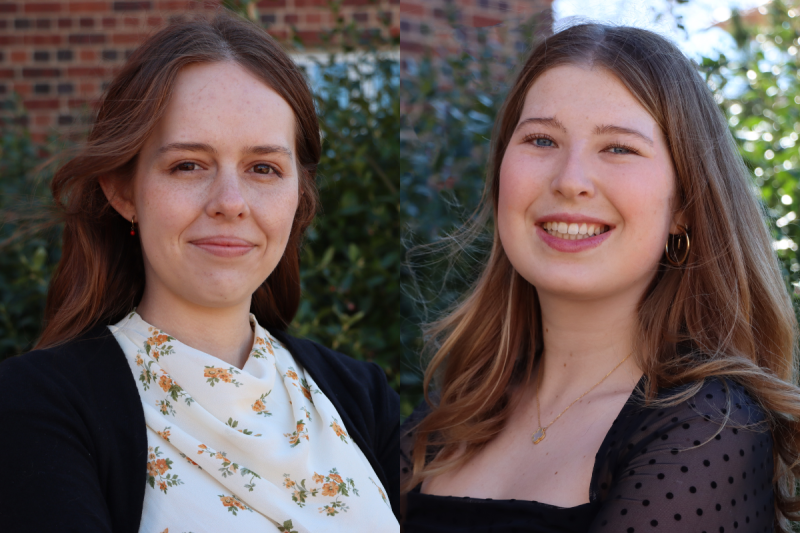
Claire Chapman & Annie Mulvihill. Photos by Hannah Fulk
Each year, graduating seniors in the Department of History, part of the College of Arts, Humanities & Social Sciences (CAHSS), present their capstone projects and engage in Q&A with DU community members in organized panel sessions. Presenting students prepare for this event through months of dedicated research, and it serves as a culmination of their academic passions and curiosities. Featured here are two history students that will present at this year’s conference and the inspiration behind their research.
Claire Chapman
What is your project, and why did you choose this area of research?
My project examines the Beck Archives’ Lowenstein Family Papers and Art to investigate the role of the donor in shaping how archival collections are interpreted and narrated. The collection tells the story of the Lowenstein family’s survival as a half-Jewish family living in Berlin during the Third Reich and World War II. I chose this topic because working with a DU-based archive allows me to study the documents in-person and interview people locally that are connected to the donation. The donor, Henry Lowenstein, who escaped Nazi persecution by going to England before the war, played a direct role in shaping the collection and guiding how students and researchers interpret it through documents and oral histories. My thesis critically examines how archive donors can influence how history is told and understood, raising questions about the implications of relying on memory and individual interpretation rather than historical analysis. By exploring the gaps and limits of personal and family archives, particularly in histories connected to the Holocaust and the Third Reich, my project highlights how donors can function in a curatorial role similar to historians and archivists, revealing both the possibilities and limitations of micro-histories in reconstructing the past.
What has been your experience as a student in the Department of History, and how have your classes and professors prepared you for a career after graduation?
The Department of History has enabled me to explore my interests and helped me determine the career path I wish to follow. Specifically, my advisor and thesis mentor Professor Elizabeth Campbell has helped me refine my historical concentration, allowing me to work at the intersection of art and history. Her dedication, alongside many other history professors at DU, has enabled me to succeed and challenged how I think about history. I cannot speak highly enough of Professor Campbell as an educator and mentor.
Annie Mulvihill
What is your project, and why did you choose this area of research?
My thesis explores the history of leprosy (Hansen’s Disease), a condition long feared not only as a disease but as a sign of moral failure and social danger. Religious teachings, sensational news coverage, and racialized beliefs historically portrayed leprosy as highly contagious and associated with immigrants and colonized peoples, leading to strict isolation policies that confined patients to institutions such as Kalaupapa in Hawaiʻi and the Carville Leprosarium in Louisiana, where many were separated from society and stripped of basic rights. I was drawn to this topic through a broader interest in the history of disease and its impact across societies, and I chose to focus on Hansen’s Disease after realizing how deeply misunderstood it remains; even I once believed it was highly contagious and essentially a death sentence. The reality of the disease is it’s far less transmissible than widely believed, and twentieth-century scientific advances and effective drug treatments have helped reframe it as a manageable bacterial infection rather than a curse or punishment. My research highlights the importance of restoring humanity to patients who were forcibly isolated, emphasizing how their advocacy challenged fear and misinformation and helped transform public understanding while dismantling the stigma that once shaped both the policies and perceptions of leprosy.
What has been your experience as a student in the Department of History, and how have your classes and professors prepared you for a career after graduation?
I have had the best experience in the Department of History at DU. My professors are incredibly knowledgeable in their respective fields and bring that expertise to the classroom. They have also done an incredible job at providing a variety of hands-on learning opportunities, whether it's through volunteering through organizations like Casa de Paz or collaborating with the Denver Veterans' Association, my professors make history come to life. They have also been incredibly supportive throughout the process of writing my thesis and have prepared me for the future by instilling a diverse array of historical knowledge in me across time and place, developing critical thinking skills, and teaching me how to effectively research and carry out a large research project like this.
Interested in learning more? The 2026 Senior History Conference will be on Friday, March 6, from 12:00 p.m. – 4:30 p.m. MT in Sturm Hall, room 454. RSVP here to support CAHSS students and their work.
Related Articles
From Pizza Origins to Veterans’ Legacies and Art Forgeries, CAHSS Professor’s Eclectic Interests Bring History to Life
Read More
Students Gain Hands-On Conservation Experience Through School of Art & Art History Internship
Read More