From Debate to Data: Janice Madden’s Lifelong Pursuit of Fairer Labor Markets
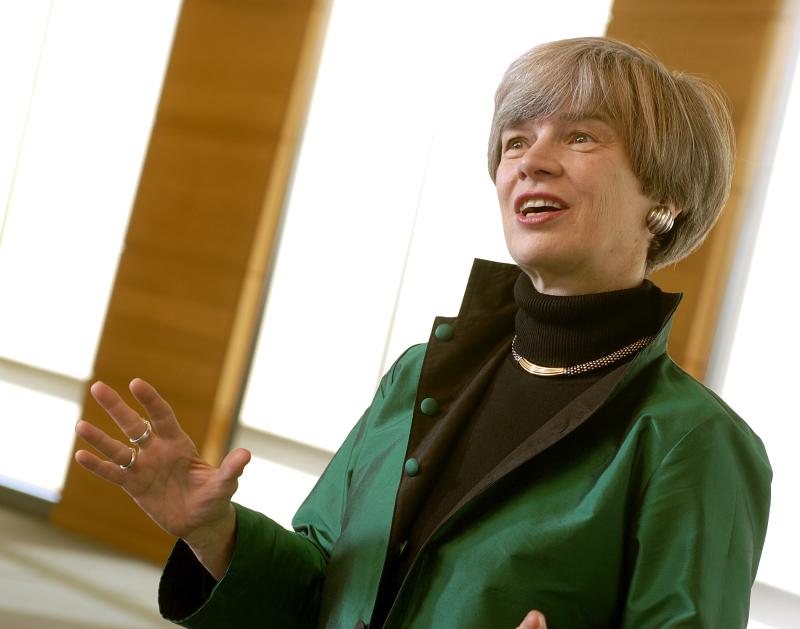
When University of Denver (DU) alumna Janice Fanning Madden (BA ’69) first arrived on campus, she planned to study mathematics. At the time, economics was the only class she could take that satisfied a requirement and fit in her already-overloaded undergraduate schedule. However, this minor academic detour would define her career.
A fifth-generation Coloradan and Boettcher Scholar, Madden quickly found her footing at DU, eventually double-majoring in economics and math. Beyond the classroom, she credits her experience on DU’s debate team, one of the state’s few prominent programs during her time there, with shaping her approach to complex problems.
"DU’s debate team showed me how to approach a problem and think through the solution,” she said. Madden remains involved in the program and hopes future DU students have the same opportunity. She sees real value in debate for student development, not just as a credential but as training in how to think.
That same habit of process — break a problem down, pressure-test the assumptions — followed her to Duke, where she pursued a PhD in economics, and then to the University of Pennsylvania’s Wharton School, where she would spend decades teaching and conducting research. Over a 50-year career, she taught courses on sex and race discrimination while developing influential theories on labor market imperfections, particularly how structural barriers affect different groups’ access to opportunity.
Her research explored how cities shape economic outcomes, including how commuting patterns affect labor markets and how caregiving responsibilities can geographically constrain women’s employment options.
A Broad Impact
Madden’s work has also had tangible, real-world impacts. Attorneys Johnnie Cochran and Cyrus Mehri asked her to examine NFL head-coach hiring practices in 2002. She found that Black NFL coaches were consistently held to higher standards than others.[HF1]
“Black coaches had much stronger records when they were hired and maintained them later,” she said. “I argued that the only reason that could be the case was that they had to meet a higher bar to be hired.”
Her findings later informed the NFL’s Rooney Rule diversity policy, adopted in 2003, which aimed to increase diversity in coaching hires. “They went from hiring three Black coaches to eight within two years of the Rooney Rule being established,” she noted. “I felt very strongly about this for the NFL and that the impact was broader than just for those in the league.”
Throughout her career, Madden often served as an expert economic witness on legal cases involving discrimination in hiring and promotion. While those cases could be contentious, she approached them with a focus on improving systems rather than assigning blame.
“There was a lot of anger in my cases early on,” she said. “If you were found guilty of prejudice or unequal opportunity, it meant you were doing something wrong. But much of that prejudice was unintentional. If you want people to do the right thing, give them guidance.”
She emphasized the importance of slowing down decision-making and using data to uncover patterns. Across all of her cases, Madden has analyzed statistically whether the stated reasons for denying promotions held up across all candidates or revealed deeper systemic bias.
“You have to do a statistical analysis to see whether you turned down everyone with those same attributes or because of ingrained biases,” she said.
Taken together, Madden's work sits at the intersection of economics and civil rights — technical enough to hold up in court, broad enough to reshape how industries from pro sports to banking think about fairness.
The Culmination of a Life’s Work
Reflecting on her time at DU, Madden is clear about how it shaped her path: “DU got me interested in economics,” she said. “I don’t think I’d be where I am without my professors.”
She believes that a foundation in the liberal arts remains essential for students today.
“What’s really important in educating students is that you teach them how to tackle a problem,” Madden said. “I care less about what the problem is and more about how you approach it and ask questions.”
Madden hopes people remember her for the work she has done in labor markets and for ensuring they are structured properly: “Because people have different backgrounds, they may demonstrate their abilities in different ways. I aim to build a system in which everybody’s ability can shine.”

Your Support Helps Us Make an Impact
Janice Madden's story shows how DU education—and mentorship—creates leaders who reshape industries.