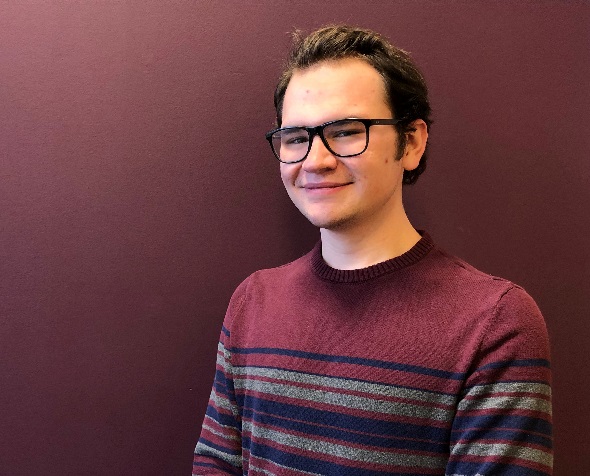
Lamont Student Profile: Anthony Wirtz
Finding His Voice Again: Anthony Wirtz’s Road Back to Music
When Anthony Wirtz first arrived in Denver, he wasn’t planning to enroll at a conservatory. He was on a Greyhound bus headed to Seattle and decided, almost on a whim, to get off in Colorado.
Nearly two decades later, Wirtz is a graduate student at the University of Denver’s Lamont School of Music, pursuing a dual Master of Music in vocal performance and choral conducting. His path back to music was anything but straightforward—shaped by hospitality work, floral design, a pandemic pivot, and a leap of faith encouraged by his husband—but music was always quietly guiding him.
A Musical Childhood in Iowa
Wirtz grew up in Belmond, Iowa, in a family where music was central to daily life. His father’s side of the family was full of singers and instrumentalists, and their Apostolic upbringing emphasized unaccompanied four-part harmony.
He showed early aptitude, picking out melodies by ear on the piano at age three. Piano lessons followed, and soon he was singing in school pageants and church. In elementary school, he sang a solo as “Silent Night” composer Hans Gruber in a Christmas program, an early taste of performance.
Music teachers encouraged him to pursue honors choirs, and in high school he was named an Outstanding Performer for North Iowa by the Iowa High School Music Association, singing “Comfort Ye” and “Every Valley” from Handel’s Messiah. Although he briefly considered careers in architecture or art education, a visit to Luther College changed everything.
While visiting his brother and sister-in-law at Luther, he was immediately captivated by Luther’s Christmas concert, which featured around 500 singers, pipe organ, and orchestra. “That was the moment I knew I wanted to audition for the music program,” he says.
Luther College and the Choral Tradition
At Luther College, Wirtz immersed himself in music, singing in choirs and playing in orchestra and band. He explored multiple instruments—saxophone, oboe, harp, and finally bassoon, which he loved for its technical demands and its connection to breath and resonance.
“The bassoon is such a great instrument for singers,” he says. “You feel the vibration all the way down. It connects support and breathing in a very physical way.”
He also studied with legendary conductor Weston Noble, who led the Nordic Choir for 57 years and shaped Luther’s choral identity. Wirtz sang under Noble for two years and credits him with inspiring his interest in conducting.
“It’s not just waving your hands,” he says. “It’s how you shape and mold the sound with sometimes very simple gestures.”
Still, Wirtz left Luther in 2005 and began a different chapter. He moved to Cincinnati, then to Denver, working in hospitality, restaurant management, apartment leasing, and eventually floral design. In 2017, after stepping in to design flowers for a friend’s wedding, he discovered a new creative outlet and built a floral business through word of mouth, eventually forming his own LLC. He has designed arrangements for weddings, baby showers, and Lamont recitals.
A Pandemic Pivot
The COVID-19 pandemic became a turning point. Wirtz was furloughed from his florist job, and his husband, Jeff—a University of Denver alumnus—encouraged him to consider returning to school.
“He said, ‘Why don’t you just audition? What can it hurt?’” Wirtz recalls.
Auditions had always caused him anxiety, but video submissions during the pandemic made the process more manageable. He recorded his materials and sent them to Lamont. A month later, he received an acceptance letter with a substantial scholarship.
“That felt like the door opening again,” he says.
He began his Bachelor of Music in vocal performance in Winter 2022 and completed the degree in 2023. In 2024, he entered Lamont’s dual master’s program in vocal performance and choral conducting, which he will complete in Spring 2027.
Bridging Singing and Conducting
Wirtz’s interest in conducting dates back to Luther, but Lamont faculty encouragement solidified his plans. After discussing his goals with Dr. Catherine Sailer and Professor Matt Plenk, he decided to pursue both conducting and voice.
“I wanted to keep a strong foundation in vocal health and technique,” he explains. “If you’re going to conduct singers, you should understand what they’re experiencing.”
He is especially interested in the relationship between solo and choral singing. While the technical fundamentals are the same, stylistic adjustments are key.
“In early music, you have to manage vibrato in a healthy way,” he says. “In a choir, you’re constantly thinking about how your sound functions within the ensemble for different repertoire and moments within. It should sound like one cohesive voice without sacrificing vocal health or individuality. It’s a delicate balance.”
Building Musical Community
Outside of Lamont, Wirtz is deeply involved in Denver’s choral community. He sings with St. Martin’s Chamber Choir, where he has also served as a conducting intern, and with the Vicar’s Choir at St. John’s Episcopal Church. He is part of Cantare Montibus, a student- and alumni-led ensemble, and participates in Coro Mundi, an international choir that gathers annually, most recently in Iceland. He is also a member of the Evans Choir led by Dr. Sailer.
These experiences reflect what draws him most to choral music: community.
“There’s something powerful and exceedingly beautiful about people coming together to make music,” he says. “It’s communal, it’s spiritual, it’s social—it brings people into the same space in a really meaningful way.”
Looking Ahead
After finishing his dual master’s degree, Wirtz plans to pursue a Doctor of Musical Arts in conducting in the next several years. His long-term goals include conducting at the collegiate and professional levels and eventually founding his own choir and orchestra ensemble.
Returning to music after nearly two decades away has been both a homecoming and a reinvention. His winding path—through hospitality, entrepreneurship, and a pandemic disruption—has shaped his perspective on artistry and education.
“I don’t take any of this for granted,” he says. “The singing, the conducting, the community—it all feels like something I was able to choose again, very intentionally, all thanks to the support of every piano teacher, music educator, director, and the Lamont staff. I especially wouldn’t be here without the unwavering support of my husband, Jeff. I owe all of this to him.”
In a conservatory world often defined by linear trajectories, Wirtz’s story is a testament to persistence, reinvention, and the enduring pull of music. From a child playing melodies by ear in Iowa to a graduate student shaping ensembles in Denver, his journey underscores that it is never too late to return to the art that first called you.