Lights, Camera, Purpose: Joe Brown on Teaching Film That Matters
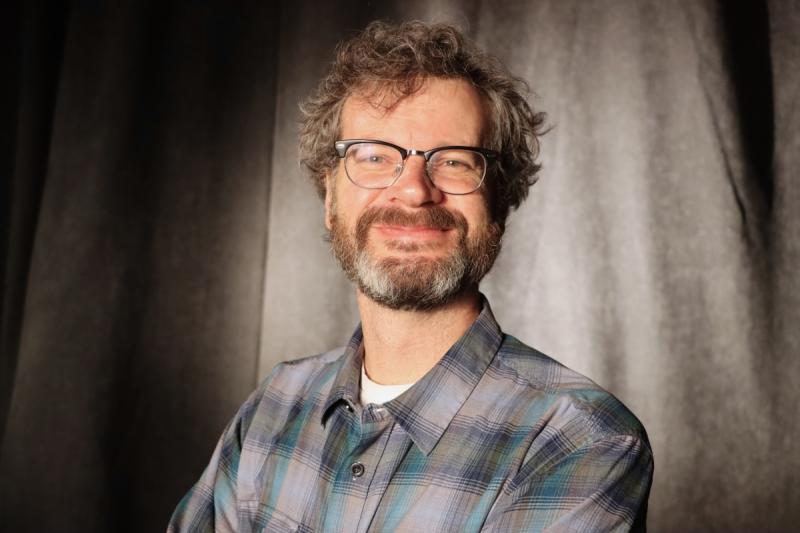
Joe Brown, associate professor in the Department of Media, Film & Journalism Studies. Photo by Hannah Fulk.
For Joe Brown, associate professor in the Department of Media, Film & Journalism Studies (MFJS) at the University of Denver (DU), film is a key storytelling tool because of its impact on people.
“Film can access multiple senses within the audience,” Brown says, “and that’s why it is quite powerful.”
In his classrooms within the College of Arts, Humanities & Social Sciences (CAHSS), this perspective of film is foundational in his teaching. While Brown's students gain extensive hands-on experience with cameras, editing, and production, he also encourages them to think more deeply about what they create and why.
“We’re not just professors who are trying to teach students to make the next Marvel movie,” Brown says. “There’s nothing wrong with a Marvel movie. We all need entertainment, but I push my students to pursue deeper storytelling than superheroes and fight scenes.”
The MFJS Mission
That “deeper work” is rooted in MFJS’s broader mission. Brown describes the department as one that prioritizes the theoretical, the technical, and social awareness, encouraging students to apply what they learn in ways that extend beyond commercial success.
Part of what makes MFJS so unique, in Brown’s eyes, is that “the skills you’re learning could be applied to storytelling for the public good,” he says.
Brown emphasizes experiential learning as a cornerstone of his courses. Many MFJS classes are practical, allowing students to build portfolio-ready work that prepares them for careers after graduation and helps them discover their passions along the way.
The Technology Treadmill
In life and in teaching, Brown consistently ponders one question: How do we balance history and the future?
Balancing the elements commonly found in MFJS courses — practice, theory, and rapidly evolving tools — means keeping pace with what Brown calls the “technology treadmill.” As innovations continue to reshape the media industry, the challenge this creates is part of what makes teaching meaningful for Brown.
He emphasizes to his students that the ethics of filmmaking are more relevant than ever, considering the rise of AI, and urges them to consider the following: “When technology takes over and becomes the thing we’re most interested in, we can lose track of the ethics of filmmaking. Are new technologies making better stories? Or are they simply making things more entertaining?”
The Lightbulb Moment
Like many faculty members, Brown teaches around five courses each year, often adding summer classes as well. “It doesn’t sound like a lot,” he says, “but it is a ton of work.”
However, for Brown, the most meaningful moments aren’t measured by workload or output, but by the growth he sees in his students.
“You don’t always know what impact you have on students,” he says, “but when I’m teaching and I see the ‘lightbulb’ go off for a student, that’s when I see my influence the most. When students come to me to chat about the social or political issues in a documentary film, I know I’m making an impact.”
It’s in those very moments, when technical skill meets personal discovery, that Brown sees the true purpose of teaching: to help his students create meaningful media, and, more importantly, understand the impact their work can have on the world.
On Truly Independent Filmmaking
Brown feels privileged to be what he calls an “academic filmmaker.” Working at a university allows for a certain independence, or freedom, from the need to make money for a film studio or investors.
“The academic freedom you have at a university, especially as a tenured professor, allows you to pursue topics that the market may not be ready for,” Brown says. "Look at my work; I’ve done films on environmental issues, including a film about someone labeled an ‘eco-terrorist,’ and I’m currently in pre-production on a film that focuses on war tax resistance.”
Brown cites that these are not topics that you easily find money for, but when you’re based at a university, you have a little more leeway to experiment and engage with stories that might be politically unpopular.

Brown’s Recent Awards and Honors
-
A Touch of Wildness: Sandhill Cranes in America
Short Documentary – Festival Release – Made with a DU Student Crew
A short film about sandhill cranes and bird conservation in Nebraska and Wisconsin.– Green Frog Film Festival, Connecticut, 2026
– Skyfire Environmental Film Festival, Arizona, 2026 -
XMAS in October: A Nativity Nightmare
Short Film Script – In Competition at Script Festivals
A short script about the excesses of consumerism and the holiday season.– New York Independent Arts Festival, Nominee, 2026
– Wiki: The World’s Fastest Screenplay Contest, Finalist, 2025
– Nevada City Film Festival, Finalist, 2025
– Los Angeles International Screenplay Awards, In Competition, 2025
– Vail Screenplay Contest, Quarter Finalist, 2025
– Visionfest International Screenplay Competition, Finalist, 2025 -
Underground Sound
Short Documentary – Festival Release – Made with a DU Student Crew
A short film about the modular synthetic music scene in Denver, CO.
– Dam Short Film Festival, Nevada, 2026
– Bare Bones International Film & Music Festival, Finalist, Oklahoma, 2025
– World Music & Independent Film Festival, Finalist, Virgina, 2025
– BreakOut Music, Movie, & Media Film Festival, Semi-Finalist, California, 2024
– Thin Line Film Fest, In Competition, Texas, 2024
– Denver Underground Film Festival, Best Colorado Film, 2023 -
The Earth is Surveilled
Short Documentary – Festival Release
A short experimental film surveilling wildlife in one remote location in Colorado.– Experimental Film Forum, California, 2024
– Castle Rock Film Festival, Colorado, 2024
– Denver Underground Film Festival, Colorado, 2023
– Animalis Fabula Film Festival, Finalist, Texas, 2022
– Colorado Short Circuit Film Festival, Colorado, 2022 -
Operation Wolf Patrol
Distributed via Journeyman Pictures, London (In English, Spanish, French, and Swedish)
A feature-length documentary focusing on environmental activists trying to end wolf hunting and poaching in Wisconsin.
25+ Film Festivals – Big Sky Documentary Film Festival, American Documentary Film Showcase, Ethnografilm: ParisBest Feature Documentary – Broadcast Education Association – 2021
Related Articles
Interdisciplinary Course Connects Biology, Astronomy, Physics and Filmmaking at Kennedy Mountain Campus
Read More
Hollywood Immersion: CAHSS L.A. Course Connects Students with Entertainment Industry
Read More