MFJS Faculty Awarded Grants to Advance Ethical AI Education
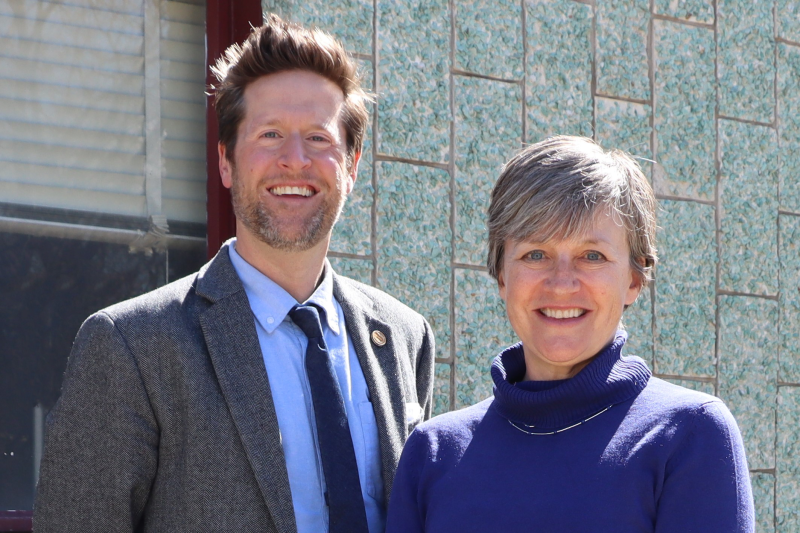
MFJS professors Andrew Matranga and Lynn Schofield Clark. Photo by Cindy Garcia-Magaña.
Two Media, Film & Journalism Studies faculty members have been awarded grants from the University of Denver's Center for Ethical Generative Artificial Intelligence Applications (CEGAIA) for new courses and curriculum helping students navigate AI's role in professional life and democratic society.
Professor Lynn Schofield Clark has received a $5,425 grant for her pilot project, "Using AI for Ethical Careers," developed in partnership with Reggie Byron, DU sociology professor and director of the Critical Race and Ethnic Studies (CRES) program. This course will introduce students to AI technologies relevant to their future careers, alongside the ethical debates and real-world consequences of AI adoption across industries. Students will hear from professionals in public service, health, education, the arts, civil society, and the sciences, then debate AI's promises and pitfalls and build a presentation connecting AI to their own career goals.
"We want students to have opportunities to experiment, become acquainted with, and consider the ways that both predictive and generative AI applications are being leveraged now in the professions they're likely to enter. I look forward to teaching this course and updating it frequently as the technology evolves."
— Lynn Schofield Clark
Professor Andrew Matranga has been awarded a $3,000 grant for his project, "Slow News, Smart Citizens: A Media Literacy Curriculum Pilot for Democratic Life in the Age of AI." This curriculum pilot will encourage students to investigate a major question at the heart of journalism and media education today in light of new AI technology: in an information environment that moves at machine speed, how do we teach students to slow down?
Both projects are rooted in the department's approach to educating students on the full life cycle of media: how it's produced, consumed, and critiqued. This new curriculum is intended to re-position those classroom conversations in a world where AI is becoming increasingly part of the media storytelling process. Students will examine how intelligent systems shape the news and information they encounter daily, and they will develop the critical frameworks needed to engage with that reality as informed citizens and media practitioners. Matranga sees the current moment not as a crisis for educators and media professionals, but as an opportunity to strengthen how MFJS teaches media production and cultural criticism in an AI-driven world.
"Every generation must learn how its information environment works. AI is simply the newest force shaping that environment."
— Andrew Matranga